header

header

Saturday, August 25, 2018

Texas Panhandle Corn Rootworm Probably Resistant to Some Bt Corn

There were a crazy lot of western corn rootworm beetles emerging from continuous corn fields this summer in the Texas Panhandle, and with seed purchase decisions on the horizon it might be a good idea to talk about Bt resistance. 

For two years now, Dr. Ed Bynum, Extension Entomologist in Amarillo, and I have seen extensive damage to Bt corn with the toxin mCry3a. These fields have been found in the zone from Dalhart in the north to Hart in the south. We have been seeing all the textbook symptoms of a failed Bt rootworm toxin: growers using soil applied insecticides in addition to their Bt seed, heavy root damage, plant lodging, lots of adult beetles on the wing because they were not killed as larvae feeding on roots, and aerial spraying of adult beetles to try and kill them before they clip silks or lay eggs that will become rootworm larvae the following year.

This year we received phone calls from consultants around Hart that were alarmed at the huge numbers of beetles and lodged plants in mCry3a corn. Dr. Bynum, Dr. Katelyn Kesheimer and John David Gonzales, IPM Agents in Lubbock/Crosby and Parmer, Bailey and Lamb counties, respectively, and I dug corn roots from several continuous corn fields near Hart. The roots from Cry34/35 corn were fine; only slight damage was observed. Roots from mCry3a corn rated 0.80 to 1.6 on the Iowa State rootworm injury scale. (Yes, we used gene-check strips to make sure the fields were mCry3a.) In practical terms this means the rootworms had removed 0.8 to 1.6 nodes of roots. EPA and the seed companies have negotiated levels of damage that might reasonably indicate there is a resistance problem, and for single toxin Bt corn like mCry3a the level is 1.0 on the Iowa Scale. Single toxin Bt fields with root ratings above 1.0 are supposed to trigger collection of beetles for resistance screening. 

Drs. Bynum, Kesheimer and Suhas Vyavhare (Extension Cotton Entomologist), and John David Gonzales and I collected 1,200 beetles from the mCry3a field mentioned above and sent them to a USDA-ARS lab for resistance screening. This process takes almost a year to complete and we will report the results when they come in. However, what we are seeing in mCry3a fields is highly consistent with what we would expect to see with resistance, so I am going to call it "probable resistance".

There are four Bt rootworm toxins in corn; mCry3a, eCry3.1Ab, Cry3Bb1, and Cry34/35. However, there is known cross resistance between the first three toxins listed above, so rootworm beetles experience these more like two toxins (mCry3a, eCry3.1Ab, Cry3Bb1) and Cry34/35. All four of these toxins have documented resistance, but resistance to the Cry3s is widespread, while resistance to Cry34/35 is only known in localized pockets – for now. 

Corn rootworm has been shown to have the ability to become resistant to single toxins in as few as four seasons when the same toxin is used in consecutive years. Most of the continuous corn fields in the Panhandle have been in Bt corn for far longer than four years, and most of them have been planted to the same toxin(s) in hybrids from the same seed company. 

The following table lists hybrids with only Cry3-type toxins for rootworm control. The toxins for caterpillar control, if any, are irrelevant to corn rootworm and are not listed.  


By far the best way to manage corn rootworms in Texas is to rotate to a non-corn crop; the rootworm larvae will hatch next year and starve because they don’t have an acceptable host. Beetles will not lay an appreciable number of eggs in a non-corn crop, so the field can be planted back to corn after just one year out of corn. 

However, crop rotation is not economically feasible in many circumstances, nor is planting a corn hybrid that does not have Bt for corn rootworm control. With pending seed purchase decisions in mind, in cases of rootworm resistance to a single toxin it is important to rotate to an entirely different toxin the following season. (Remember that mCry3a, eCry3a.1Ab and Cry3Bb1 are not very different as far as corn rootworm is concerned.) As far as we know, there is no resistance in Texas to Cry34/35. Every transgenic seed company has hybrids with Cry34/35, sometimes as the sole rootworm toxin but often in combination with one or more of the three Cry3-type toxins mentioned above. It might be a good time to contact your seed dealer and determine whether there are agronomically acceptable hybrids with Cry34/35 that can replace the hybrids that have only Cry3-type toxins. 

Determining the types of Bt toxins present in hybrids from every seed company is easy to do, just visit the Handy Bt Trait table

Wednesday, July 25, 2018

What's Up With All the Earworms in Bt Corn?

This is a jointly issued article from Extension Entomologists Drs. Pat Porter (Lubbock) and Ed Bynum (Amarillo).

There are large numbers of corn earworm larvae in Bt corn ears in the Texas Panhandle, and some people are spraying in an attempt to control them. 

The first question we are getting is what to spray, but the better question would be whether to spray. Corn earworm is usually an ear tip feeder, and on its own is seldom an economic pest of corn. However, this year we are seeing earworms doing more than just tip damage, and feeding lower in the ear. The reason(s) for this change in behavior are unknown. 

We have not forgotten last year though, when there was good evidence that just a little ear tip damage resulted in higher fumonisin levels. This could happen again this year, especially if the weather in August and September turns off wet and relatively cool. However, based on what we saw last year, the little bit of tip damage needed to promote fumonisin has already been done this year, so the contribution of ear damage to in-season fumonisin levels will depend largely on the weather between now and harvest.

Corn earworm eggs are laid on silks, and the small larvae feed on silks as they move toward the tip of the ear. Silks continue to grow for several days, so new growth will not have insecticide residue on it. That is in part why sweet corn growers often spray on a three-day schedule. Once inside an ear the larvae cannot be reached with insecticides. They only leave the ear when fully grown as they move toward the soil surface to tunnel in for pupation, but by this time all of the damage is done. And these fully mature larvae don’t feed much, so they won’t get an insecticide dose except by direct contact. 

There is very little benefit to trying to kill them while they are in the ear and after they finish doing damage. Corn earworm control for next year is not like western corn rootworm control. Western corn rootworm has one generation per year, and the beetles emerging in a field tend to stay in that field to lay eggs in the soil. The theory of spraying rootworm adults to control next year’s root feeding is that if most of the beetles can be killed before they lay eggs, the number of rootworm larvae the next year will be reduced. Corn earworm, however, is highly mobile has several generations, and multiple hosts to develop on. The immigrant moths come up from the south in spring and early summer, and immigration continues throughout the summer as locally reproducing populations increase as well. Corn earworm does not overwinter on the northern High Plains, so killing larvae as they leave the ear will have no effect on next year’s population. It might slightly reduce the number of moths in the next generation this year that will lay eggs in cotton (see below), but only slightly, and at significant expense. 

Western bean cutworm complicates things, but its management should follow established procedures and guidelines presented on page 17 here. Western bean cutworm has been shown to be resistant to Cry1F, the only older Bt toxin that provided any significant control or suppression. Cry1F Bt corn should be scouted and treated as if it was non-Bt corn. 

The second question we are getting is why all of the earworms? One answer would be that they have become resistant to most of the toxins in Bt corn. Dr. David Kerns, IPM Coordinator at College Station, has been running resistance assays on field collected populations of corn earworm (cotton bollworm) collected in central Texas and has reported significant levels of resistance to the once-partially-effective toxins Cry1Ab and Cry2Ab2. Cry1F never was very effective, and Cry1A.105 is a synthesized version of these toxins. 

The bollworm/earworm populations we have on the High Plains are comprised largely of moths that flew in from south and central Texas, so it would be no surprise to find they carry alleles (genes) for resistance to the older Bt toxins. Dr. Ed Bynum, Extension Entomologist in Amarillo, will collect larvae from a Bt corn field with high numbers of larvae in the ears tomorrow and send these to Dr. Kerns for laboratory screening for resistance. John David Gonzales, Extension Agent IPM in Parmer, Bailey and Lamb counties, sent a collection of 250 larvae from a Bt problem field to Dr. Kerns this week. The laboratory screening will take a couple of months to complete and the findings will be reported here. 

The third question we are being asked is what does this mean for Bt cotton which shares many of the same or similar toxins found in Bt corn.The answer is that we don’t know for sure, but we can pose a couple of scenarios.  

Corn earworm (cotton bollworm) greatly prefers to lay eggs in corn rather than cotton or sorghum. When given the choice between only cotton and sorghum, it tends to prefer sorghum more. But we have relatively little sorghum in the system this year. In areas where the corn planting is spread out over time, moths emerging from earlier planted corn will seek to lay their eggs in later planted corn that is silking or somewhat past green silk. This scenario played out last year on the High Plains, and the later corn intercepted a lot of the egg laying that would otherwise have gone to cotton if the later corn was not around. 

However, where much of the local corn crop is planted relatively early, there may not be later corn and sorghum available to draw the moths away from cotton. It is certainly possible in this situation that the moths emerging from corn will lay a high percentage of their eggs in cotton. If there is resistance to the Bt toxins in corn, the resulting larvae will be resistant to most of the Bt toxins in cotton. 

The one Bt toxin that is still highly effective on corn earworm (cotton bollworm) and western bean cutworm is Vip3a. Corn with Vip3a will not produce many moths at all, and cotton with Vip3a will not have much damage. The “Handy Bt Trait Table for US Corn Production” makes it simple to determine the Bt toxins in any commercialized corn. 


Thursday, July 19, 2018

Bollworm situation: West Texas cotton


I am glad folks are paying attention to what is happening in other areas. I had a few calls regarding bollworms this week--mostly in response to the hubbub in Central and South Texas. So far, worm pressure in cotton have remained light for the most part with some areas (e.g. parts of Swisher, Floyd, and Hale counties) just starting to show increase in numbers.

Our Bt sentinel research plots at Texas A&M AgriLife Research and Extension center in Lubbock are showing a few worms in non-Bt plots—no activity has been spotted in any of the Bt technology plots so far. As the season progresses, we may see increase in moth flights and the egg lay.

I wouldn’t spray for bollworm egg lay in West Texas cotton as very few eggs make it to worms (thanks to beneficials!). Treatment decisions should be made based on the amount of fruit injury and the presence of live worms in both Bt or non-Bt fields. Since newly hatched larvae must feed on the plant for the Bt toxin to be effective, delay decision making until you can determine the survivorship of larger worms. The threshold level before bloom is 30 percent or more damaged squares with worms present. After boll formation, the threshold is 6 percent or more damaged fruit with worms present.

Many of you are aware of the situation of worms breaking through some of the Bt traits across various cotton producing regions including the parts of Texas. We may experience similar events in the High Plains cotton if it turns out to be a heavy bollworm year. For now, let’s hope it remains a quiet one but don’t let your guard down. Irrespective of what Bt traits you have, keep scouting and be on the lookout.  Remember, once worms increase in size and dig into the lower plant canopy, it’s hard to get them even with the most effective diamide insecticides.

Monday, July 9, 2018

Sugarcane Aphid Arrives on the Texas Southern High Plains

Kerry Siders, EA-IPM in Hockley, Cochran and Lamb counties, just reported that Danny Quisenberry, a crop consultant, found sugarcane aphids on older grain sorghum four miles north of Earth in northern Lamb County.

Additionally, Greg Cronholm, a private crop consultant, just reported sugarcane aphids on sorghum in southern Castro County.

Neither of these populations is at a treatable level, just small colonies on isolated plants at present. If this year's infestation pattern follows those of 2014-2017, then it is likely the aphids are already present in Hale, Floyd and Lubbock counties, although we have had no reports of this as yet.

Wednesday, June 20, 2018

Sustained High Numbers of Fall Armyworm Moths

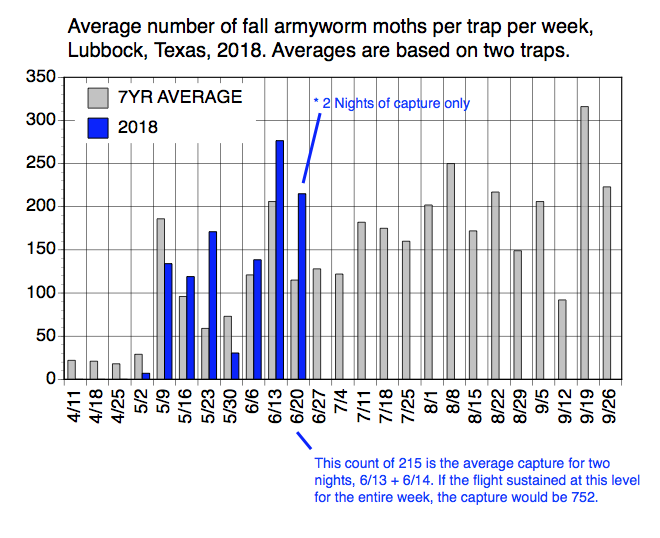
This week's fall armyworm pheromone trap graph appears below. The 7-year average for this week of June is 110 moths per week. This week's capture was 707.

This does not appear to be a phenomenon confined to the Lubbock Research Center, as Katelyn Kesheimer, EA-IPM in Lubbock and Crosby counties, reported several hundred moths in the Crosby County traps she operates. (Rain filled the traps so it was not possible to count all the moths, but there  were hundreds.) Additionally, Blayne Reed, EA-IPM in Hale, Swisher and Floyd counties, drove to Plainview from College Station late last week and reported that fall armyworm moths were very abundant at rest stops along the way.

A prior post from April of this year discussed some genetic work being done by Ashley Tessnow, a graduate student in the Dept. of Entomology at College Station. She determined that the Lubbock area fall armyworm moths we sent her last year were 30% rice strain and 70% corn strain as a season average. She also noted that the relatively big flight toward the end of June last year had 93% corn strain.

We don't know where these moths are coming from. Some are doubtless progeny of the moths that arrived here earlier in the season, but it is likely a majority of the moths caught this week have come up from south Texas. Ashley's work will ultimately help us to know the geographic origins of our moths.

Most Bt corn will not get appreciable damage, but non-Bt corn should be scouted. Yesterday I noted that there were a lot of newly hatched larvae in my non-Bt corn at the Experiment Station just as the oldest larvae were cycling out. Actually there were a lot of plants infested by larvae from egg masses that had hatched in the last 24 - 48 hours. Some of these newly infested plants had four or more larvae per whorl and may get "dead heart" due to the very high numbers of caterpillars feeding on the youngest leaves in the whorls. Sorghum should be scouted as well.


Information on scouting and thresholds can be found for corn here and sorghum here. Essentially, both of these crops can withstand 30% whorl damage before an insecticide is justified. This does not, however, apply when deadheart is likely to happen. There are a few fields of corn in the area that are silking now, and these should be scouted regardless of whether they are Bt or non-Bt. 

While scouting it would be a good idea to look for corn earworm eggs and larvae; the moths are very abundant in my whorl stage corn although I do not have any pheromone trap data to report. 

Friday, June 15, 2018

Fall Armyworm Trap Captures Very High at Lubbock

My post two days ago said fall armyworm captures in pheromone traps were a bit above average and that it seemed we were at the start of a big flight. The traps were emptied on Wednesday, and today they had an average of 215 moths per trap.

To put this in perspective, the 7-year average for this week of the season is 115 per WEEK. So in just two nights the capture we are already 87% above the historical weekly average. There is no way to know if the numbers will remain at their current level for five more nights, but if they did then next Wednesday I would report 752 moths per trap.

Regardless of how things go for the next five days, we are now well above the 7-year average. My non-Bt corn is taking significant damage, and this is before most of the caterpillars are anywhere near large. Egg masses are easy to find.

The good news is that fall armyworm is not generally a big problem very far north of Lubbock. My colleagues and I checked research plots with non-Bt corn at both Halfway and Bushland this week and found very little damage from either fall armyworm or corn earworm. However, this might not be the case next week, especially at Halfway.


Wednesday, June 13, 2018

Mid-June: Mostly Good for Corn and Sorghum, Fall Armyworm High

It is mid-June, and I am pleased to report that there have not been any serious insect problems in corn and sorghum yet. Well, let me temper this by saying that the drought has brought plenty of problems outside the entomological realm.

Wireworms have been a problem in spotty areas, but for the most part seed treatments have kept them in check. Corn in the area is approaching V6 - V8, and sorghum is anywhere from V5 to still in the bag. Sugarcane aphids have not been detected on the High Plains, but sorghum planted relatively late will benefit from seed treatments to control sugarcane aphids, at least if prior years are a predictor. The progress of sugarcane aphid can be tracked here.

Fall armyworm trap captures just jumped up, and the weekly average exceeds the 7-year average at Lubbock. We may be at the start of a big flight; last night's capture was 124 moths per trap, whereas the nightly average for the prior six nights was only 25.4.


I have non-Bt heirloom dent and sweet corn planted at the Lubbock Experiment Station, and the caterpillar damage is moderate or worse depending on the variety or hybrid. (These old varieties, the ones without any insect resistance, give me an idea of the "worst case" of what is happening.) I have been monitoring modern field corn in the Lubbock area, and non-Bt hybrids have had only light to moderate fall armyworm damage for the most part. The worst I have seen had an average rating of 5 on the Davis 0-9 scale, with zero being no damage. There were pockets of plants with 7-8 damage. The Bts have been holding up and show little damage.

The good news in corn is that we still don't have any indication that our Bts are breaking down on the High Plains. In more southerly parts of Texas and elsewhere in the south, Bt corn is showing considerable susceptibility because corn earworm (cotton bollworm) has become resistant to some of the Bt toxins. However, we have no evidence that those resistance genes have made it here to any great extent. Most of our area corn is Bt, and this means that fall armyworm and corn earworm (and southwestern corn borer) will not pose a threat in the whorl stage.

In summary, things are pretty good at the moment, except for fall armyworm. Small colonies of spider mites have been found, but they have disappeared, probably due to predation by thrips coming off of wheat. We will continue to watch for the arrival of sugarcane aphids in sorghum; they hit in the third or fourth week of June the last two years and required treatment starting in mid-July, but every year is different and this year feels like they might be late.