header

header

Friday, June 15, 2018

Fall Armyworm Trap Captures Very High at Lubbock

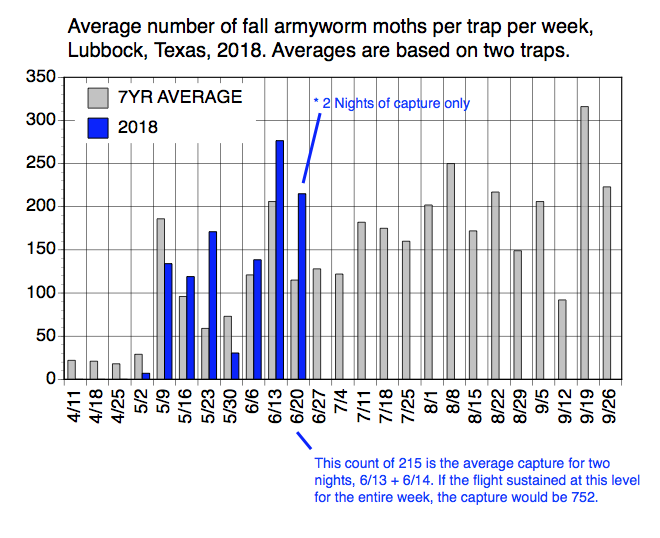
My post two days ago said fall armyworm captures in pheromone traps were a bit above average and that it seemed we were at the start of a big flight. The traps were emptied on Wednesday, and today they had an average of 215 moths per trap.

To put this in perspective, the 7-year average for this week of the season is 115 per WEEK. So in just two nights the capture we are already 87% above the historical weekly average. There is no way to know if the numbers will remain at their current level for five more nights, but if they did then next Wednesday I would report 752 moths per trap.

Regardless of how things go for the next five days, we are now well above the 7-year average. My non-Bt corn is taking significant damage, and this is before most of the caterpillars are anywhere near large. Egg masses are easy to find.

The good news is that fall armyworm is not generally a big problem very far north of Lubbock. My colleagues and I checked research plots with non-Bt corn at both Halfway and Bushland this week and found very little damage from either fall armyworm or corn earworm. However, this might not be the case next week, especially at Halfway.


Wednesday, June 13, 2018

Mid-June: Mostly Good for Corn and Sorghum, Fall Armyworm High

It is mid-June, and I am pleased to report that there have not been any serious insect problems in corn and sorghum yet. Well, let me temper this by saying that the drought has brought plenty of problems outside the entomological realm.

Wireworms have been a problem in spotty areas, but for the most part seed treatments have kept them in check. Corn in the area is approaching V6 - V8, and sorghum is anywhere from V5 to still in the bag. Sugarcane aphids have not been detected on the High Plains, but sorghum planted relatively late will benefit from seed treatments to control sugarcane aphids, at least if prior years are a predictor. The progress of sugarcane aphid can be tracked here.

Fall armyworm trap captures just jumped up, and the weekly average exceeds the 7-year average at Lubbock. We may be at the start of a big flight; last night's capture was 124 moths per trap, whereas the nightly average for the prior six nights was only 25.4.


I have non-Bt heirloom dent and sweet corn planted at the Lubbock Experiment Station, and the caterpillar damage is moderate or worse depending on the variety or hybrid. (These old varieties, the ones without any insect resistance, give me an idea of the "worst case" of what is happening.) I have been monitoring modern field corn in the Lubbock area, and non-Bt hybrids have had only light to moderate fall armyworm damage for the most part. The worst I have seen had an average rating of 5 on the Davis 0-9 scale, with zero being no damage. There were pockets of plants with 7-8 damage. The Bts have been holding up and show little damage.

The good news in corn is that we still don't have any indication that our Bts are breaking down on the High Plains. In more southerly parts of Texas and elsewhere in the south, Bt corn is showing considerable susceptibility because corn earworm (cotton bollworm) has become resistant to some of the Bt toxins. However, we have no evidence that those resistance genes have made it here to any great extent. Most of our area corn is Bt, and this means that fall armyworm and corn earworm (and southwestern corn borer) will not pose a threat in the whorl stage.

In summary, things are pretty good at the moment, except for fall armyworm. Small colonies of spider mites have been found, but they have disappeared, probably due to predation by thrips coming off of wheat. We will continue to watch for the arrival of sugarcane aphids in sorghum; they hit in the third or fourth week of June the last two years and required treatment starting in mid-July, but every year is different and this year feels like they might be late.

Friday, June 8, 2018

Should I be on the lookout for thrips?


I have noticed some thrips damage on the early planted cotton especially in the areas north of Lubbock. Fields that have already reached 4 true-leaf stage are pretty much safe from further thrips damage. We still, however, have a lot of late-planted cotton in South Plains that ranges from emergence to 1st or 2nd true-leaf stages which are very prone to thrips injury. Late planted cotton usually escapes peak thrips flight but the fields at the most vulnerable stages especially those in the vicinity of maturing wheat or pastures will have to be watched closely for thrips.

In general, with the current hot and mostly sunny days, I would not be too aggressive when it comes to spraying as cotton plants can outgrow thrips under good growing conditions. Having said that, I wouldn’t wait too long either if the damage is being done. Spraying for thrips after the 3rd true-leaf stage contributes little towards the yield—so the timing is critical!

What are thrips?
Thrips are early-season pests of seedling cotton. They are numerous in cotton grown near maturing small grains (wheat) or seedling corn. Thrips attack leaves, leaf buds, and very small squares (flower buds), causing a silvering of the lower leaf surface, deformed or blackened leaves, and terminal and square loss. Feeding most often occurs in the new terminal growth and on the underside of the leaves. Their feeding ruptures cells, causing stunted plants and crinkled leaves that curl upward. Severe infestations can destroy terminal buds, causing excessive branching of the plants and delayed plant growth.
No damage to severe thrips damage

How do I scout for thrips?
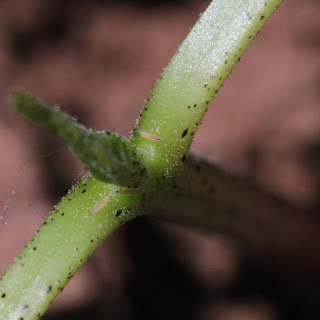
Begin inspections once the cotton reaches approximately 50 percent stand emergence. Thrips can migrate in great numbers from adjacent weeds or crops, especially small grains (wheat), and cause significant damage within a few days. Randomly select 20-25 plants from different parts of the field and closely examine them, looking for adult and immature thrips. Look carefully through the terminal growth, picking it apart with a pencil lead or other pointed object, uncurling all the leaves—thrips often hide in tight locations, especially during rainy, windy conditions.
Thrips on plant terminal
What are the thresholds and control options for thrips?
The threshold for thrips is 1 thrips per true leaf (i.e. at 2 true leaves, it would be 2 thrips per plant; at 3 true leaves, the threshold would be 3 thrips per plant and so on). Research shows that applying foliar sprays after significant thrips damage has occurred results in little or no benefit. Base your decision to apply insecticide on the number of thrips present and the plant development stage. Foliar insecticides for thrips provide maximum benefit when applied at or before the second true leaf emerges. Sprays at the four and five-leaf stage after the damage is already done are typically for revenge, rather than yield.

Seed treatments with neonicotinoids (e.g. imidacloprid and thiamethoxam) are still proving to be effective controlling thrips in the Texas High Plains region. However, under heavy thrips pressure, foliar treatment is often needed on the top of seed treatment. Presence of immatures and injury symptoms on plant are good indicators of whether the seed treatments are working or not. As far as foliar treatments are concerned, acephate, dicrotophos (e.g. Bidrin 8EC), and spinetoram (e.g. Radiant SC) all provide an excellent thrips control. You can tank mix your insecticide with a post emergence herbicide application. The decision you will likely make is whether to be timely for the weeds or the thrips. Remember, no insecticides are approved for tank mixing with applications of any dicamba products in cotton.

Thursday, May 10, 2018

Wireworms in Texas High Plains Cotton


I have received a few queries regarding wireworms lately. Here is some info to answer some of the common ones.

What are wireworms
Wireworms are a common cotton pest which feed on germinating seeds and emerging seedlings. Two types of wireworms feed on cotton: true wireworms and false wireworms. True wireworms, commonly called click beetles, are members of the Elateridae family, while false wireworms, or darkling beetles, are from the Tenebrionidae family.
Click beetle
Darkling beetle


Damage
Wireworm larvae (Photo: Pat Porter)
Overwintering larvae inflict the most damage as they become active in the spring. The larvae damage cotton by feeding on the root, hypocotyl (stem of the germinating seedling), and cotyledon (seed leaves) of plants before emerging from the soil. Root feeding can kill plants and reduce plant stand but usually results in stunting.

Scouting
It’s hard to find crop worms that you can’t see! Soil-dwelling habit of larvae makes it very challenging to scout for. Baits with mixture of either wheat grain or oatmeal and honey may help detecting the presence of wireworms in field.

Management
There are no rescue treatments. Minimize wireworm infestations through clean cultivation and fallowing. Infestations are most severe in no-tillage or reduced-tillage situations, particularly following grain crops. Planting shallow and under warm conditions allows cotton seeds to germinate rapidly and plants to outgrow wireworms. Insecticidal seed treatments and/or at plant insecticides are the most effective means of minimizing wireworm damage.

Can compost application make problem worst?
No, unless the compost is carrying any wireworms or their eggs. In general, compost can provide better environment for wireworms that already exist in the field but there are little or no data available on this.                                                                                                                          

Need more info?
Access our online fact sheet on wireworms at: http://agrilife.org/lubbock/files/2017/05/Wireworms_ENTO-068.pdf


Thursday, April 12, 2018

As Crop Threats, All High Plains Fall Armyworms Are Not The Same

We all respect fall armyworm as a significant threat to High Plains corn, sorghum and cotton, and that is why we run pheromone traps to assess the potential threat during the growing season. Last year we sent some of our moths to Ashley Tessnow, a graduate student working with Dr. Greg Sword in the Dept. of Entomology at College Station. She is looking at the population genetics of fall armyworm.

She sent some of her preliminary results this week, and they were a surprise; based on just 2017 moths, we seem to have a baseline level of around 30% "rice" strain. There are two strains of fall armyworm, and the rice strain feeds on rice, Bermudagrass and Johnsongrass (but can feed on corn). The "corn" strain feeds on corn, sorghum and cotton. In another surprise, the baseline level of about 70% corn strain jumped to 93% in the late June sample when we had a sudden influx of high numbers of moths for just a few days. 

I sent Ashley a draft of this text, and she wisely added the following comment. "An important caveat is that the corn versus rice strain determination is based on a single mitochondrial gene. It is possible that there could be hybridization between the moth strains that were originally pure corn and rice before beginning their migration from south Texas earlier in the year."Ashley’s more detailed genome-wide sequencing of these moths will help us know if this is occurring.

Ironically, Ashley's data arrived at the precise moment Blayne Reed, IPM Agent in Hale, Swisher and Floyd counties, and I were discussing a research trial to determine whether we could time insecticide sprays in corn based on fall armyworm pheromone trap captures. Spraying on trap captures is not a good idea in most cases, but fall armyworm eggs are difficult to scout for and the treatment window after they hatch is very short. Ashley's data told us that a) we might not know what proportion of the moths in a trap are a threat to corn, and b) the proportion that are a threat seems to vary significantly (and unpredictably) over the season. And, well, c) our assumption that High Plains fall armyworms are almost entirely corn strain is probably wrong, but that is really good to know. Suffice to say that it is not likely we can develop a treatment threshold based on trap captures. 

Our pheromone trapping project still has great value in telling us when moth activity is high and crops are at risk. However, thanks to a graduate student at Texas A&M we now know that we need to interpret our trap data cum grano salis, which, if you missed it in logic class, means with a grain of salt. 


Monday, February 5, 2018

All New Guide to Manage Cotton Insects is Now Available

Entomologists with Texas A&M AgriLife Extension Service have released a new statewide guide on managing insect pests of cotton.

The highlights of new guide include 1) description of economic arthropod pests of cotton in Texas, including their associated damage to crop growth stages, 2) description of the various sampling methods for these pests, 3) information on Bt traits available in market and their relative efficacy, and 4) description of action thresholds and management tools for each pest.

Here is a link to access online version of the guide.

It can also be downloaded from the Texas A&M AgriLife Extension bookstore at no cost.


Friday, February 2, 2018

Texas Receives Section 18 for Transform for Control of Plant Bugs in Cotton

Suhas Vyavhare, Extension Cotton Entomologist, Texas A&M AgriLife Extension Service


The EPA has approved the Section 18 Emergency Exemption for use of Transform WG in Texas to control plant bugs in cotton. This exemption is effective March 1, 2018 and expires October 31, 2018.

Pests and application rates: Plant bugs (1.5 – 2.25 oz Transform WG per acre)

Spray drift management: Applications are prohibited above wind speeds of 10 mph

Restrictions:
-    Pre-harvest Interval: Do not apply within 14 days of harvest.
-    A restricted entry interval (REI) of 24 hours applies to all applications.
-    Minimum Treatment Interval: Do not make applications less than 5 days apart.
-    Do not make more than four applications per acre per year.
-    Do not make more than two consecutive applications per crop.
-    Do not apply more than a total of 8.5 oz of Transform WG (0.266 lb ai of sulfoxaflor) per acre per year.